Showing posts with label Flashcards. Show all posts

Tuesday, April 29, 2014

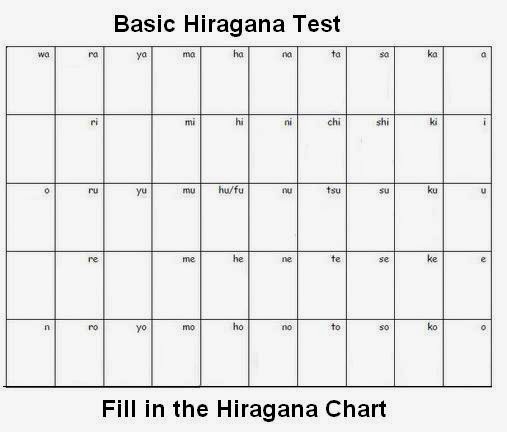
Basic Hiragana Test

Okay guys, I have given you tons of time to study, and now it's time to take the test and see where you are at with your Basic Hiragana Skills.  Please keep in mind that if you fail to memorize the basic hiragana, then you will really have a hard time in future lessons, because within the next month, after we learn the combinations, I am going to be posting example sentences in Japanese, and I will NOT be providing romaji. You will need to be able to read the hiragana, and, eventually, the katakana.

The flashcards for all 46 hiragana are HERE (they are multiple choice, but it's 1 out of all 46).

Now, being as I have LEARNED these before, I will tell you... Being able to recognize the hiragana is not the same as KNOWING them.  If you can't, from memory, produce a 'ku' or a 'ya' or a 'nu', without having to have the hiragana in front of you, then you don't actually KNOW them.

And that is why, the ultimate test of your skills is right here.  Fill in the chart.


This concludes the test post.

The next post we will be learning the diacritic marks and combinations, which modify the basic hiragana and using those relatively simple add-ons, you can make all 270 or so sounds in the Japanese language.

Wednesday, April 16, 2014

Final Basic Hiragana Post - Week 4

Okay, I've given you guys like 3 weeks to play "catch up", so now I'm going to be posting the final 2 series from the basic hiragana set.

First off, we will be doing the Y-series, and then the W-series (which includes N/M).  Both series only have 3 characters each.

NEXT WEEK WILL BE YOUR FIRST ACTUAL *TEST*, AND IT WILL COVER ALL OF THE BASIC HIRAGANA.  *THESE TESTS ARE MEANT TO HELP *YOU* TRACK YOUR PROGRESS, SO IF YOU CHEAT, YOU WILL HURT NO ONE BUT YOURSELF!

We are also going to be discussing what it means when you see half-sized characters, and introduce you to the concept of paired hiragana to make more sounds, as well as the two diacritic marks, which also make more sounds.  We won't be covering them all in-detail this week, however we will be introducing them.

Okay, so here are they are. And, because there are only six characters, we'll be treating them as essentially one series with the FLASHCARDS on quizlet, which are available HERE. (As usual, just click on 'study' or 'Learn' to go through the set... This time, they are set up to be multiple choice.  Let me know if you guys like the change or not.)

Y-series is
Ya  や
Yu ゆ
Yo よ
Full size PDF for printouts available HERE:


And the W-series
Wo/O を
Wa  わ
N/m  ん
Full Sized PDF for printouts available HERE


Now, we are going to talk just a bit about what it means when we see a half sized character.  There are only 4 characters which will appear half-sized.  They are as follows:

Tsu - つ っ

When you see a half-sized っ (tsu) character, this indicates that the next sound should have a slight pause there, or be extended a bit.  So, if you see わかった (wakatta - to understand), that would break down like this

wa-ka- tta
わ - か - った
wa - ka - t ta

The 't' there in 'ta' must be doubled to 'tta', because the small 'tsu' indicates this.

Another, very popular example, would be Sesshoumaru's name.

His name is written out in hiragana like this:

せっしょうまる (殺生丸)
Se-ssho-u-ma-ru

You will notice that his name also has a half-sized 'yo' right after the 'shi'.  When you see the half-sized 'yo', 'yu' or 'ya', they create "blended" sounds using combination hiragana.  In this case 'shi' blends with the 'yo' sound, to make 'sho'.

Because the 'sho' has a half-sized 'tsu' in front of it, the 's' must be doubled there as well, so it breaks down as:
せ* っしょ * う * ま * る
Se - s sho -  u -  ma - ru

The half-sized Y series look like this (with full size first, for comparison):

Ya - や ゃ
Yo - よ ょ
Yu - ゆ ゅ

Other popular words that use half-sized characters are

Chan (familiar suffix, used for women and young children)
ちゃん
Chi+ya = Cha n

Ottosama - (Husband)
おっとさま
O - t to - sa - ma

Juu (The number 10 ) 
じゅう
Ji+yu = Ju
Ju - u

Ja nai (negation, 'is not')
じゃない
Ji+ ya = Ja
Ja nai

Bishounen (Beautiful young boy/Pretty boy)
びしょうねん
Bi - Shi+yo - u - ne-n
Bi - Sho - u - ne - n

Kyuu (The number 9 )
きゅう
Ki+yu - u
Kyu - u

Shoujo (Young woman)
しょうじょ
Shi+yo - u - Ji+yo
Sho - u - Jo

Josei (Adult women)
じょせい
Ji+yo - se - i'
Jo - se - i


I hope you are starting to get the idea, but if not, don't worry.  We'll be going over this a lot more.

Also, you may have noticed diacritic marks on some of the characters.  The two dots that changed  shi  し into  じ ji...  We will be going over those in our next lesson.  They are actually really easy to pick up, so don't worry. 


Tuesday, March 18, 2014

Hiragana 3, Week 3

Hi there! So, it's been another 7 days and it's time for a new lesson.   As with the previous lessons, we will be focusing on learning the Hiragana.   You may notice that I don't always teach you in the same order as shown on the chart, and that is because we are not here to memorize one chart, but to learn how to recognize these characters in any context.

Going along with that, we are going to learn the H-series, the M-series, and the R-series this week.

This week is the LAST WEEK that we will be focusing ONLY on Hiragana.  There are only six characters left to learn after this, and so next week, we will have our first lesson in the basic grammar, and we will learn the 'wa' topic marker particle, and the verb 'desu' and it's conjugations.  After that, we will learn some more about hiragana, including dicritic marks and combinations, but for now, I want to teach you guys at least a few phrases and basic sentence structure, so no one feels frustrated thinking, 'Okay but when are we going to learn to SAY THINGS?!?'   Above all, I want this to be educational AND useful, AND as fun as I can make it for you all.  : D

So anyway, I think you guys know how this goes by now.

FLASH CARDS FOUND HERE

The H-series is as follows (notice that there is no 'hu', but rather, 'fu' takes it's place):
Ha - は
He へ
Hi ひ
Ho ほ
Fu ふ

Large printable PDF version found here.


The M-Series is as follows:
Ma  ま
Me め
Mi み
Mo も
Mu む

Large PDF version found here.


And the R-series is as follows:
Ra  ら
Re れ
Ri り
Ro ろ
Ru る

Large printable PDF version found here.


Wednesday, March 12, 2014

Hiragana 2, Week 2

Hey there! So, you've all had 10 days now to study those 10 hiragana I gave you last time... How do you think you're doing?  I'd say most of you seemed to do pretty well with them, based on the feedback I've gotten.

Because many of you said that you found this lesson to be... less than challenging, I'm going to change up a bit here and go just a *little* bit faster, to keep you guys from getting bored.

Today, we're going to focus on the S-series, the T-series and the N-series.

Flash Cards to be found Here

Please be aware that the T-series and S-series have a few characters that don't fit the usual pattern.  These are  Chi, ち、Tsu つ、and shi し. These have three letters that make up their sounds, instead of two.

This means the T-series is as follows:
Ta -  た
Te -  て
Chi - ち
To  - と
Tsu - つ

PDF version found here


The S-series is as follows:
Sa - さ
Se - せ
Shi - し
So - そ
Su - す

PDF version found here


And the N-series is as follows:

Na - な
Ne - ね
Ni - に
No - の
Nu - ぬ

PDF version found here


Sunday, March 2, 2014

Week 1, Hiragana 1

The first and most important step to learning Japanese is to learn the basic hiragana.  We will learn 10 new hiragana each week.  I have created flashcards on a Quizlet Account called Basic Japanese, and provided practice sheets you can save to your computer as .jpg images, and also links to the PDF files from the original source page, that you can save and print out full-size.

1) Writing them down "drill style".  You can practice writing the hiragana down individually, while saying the sound they make over and over to yourself as you write them.  Personally, I found this method extremely effective.  The stroke order is IMPORTANT so please pay close attention to it.   There are links to practice sheets below.

2) Flash cards - You can use flash cards to try and memorize the hiragana.

I have created a set of Flash Cards, with pronunciation available (hover over the hiragana and click the audio symbol to hear it pronounced on Quizlet.  You can find them here under the name Week 1 Hiragana Flash Cards, and the account Basic Japanese. To go through the set, simply click on the 'learn' tab above the list.  You can also choose only certain flash cards to display by clicking on the star next to the ones that you want shown to you.

3) You can also try to come up with memory aids to help you.  For instance, I always remember ki because the character き almost looks like a key that unlocks a door if  you turned it sideways.  U う looks like the letter U if you turned it sideways, etc.,  You will find and discover various memory aids as you go along and think to yourself 'hmmm this looks like this kind of', and that can help it to stick.

For the  A あand O お, that look so similar, I remember them because the 'O' charcter looks more like a rounded letter 'o' on the bottom, where the 'a' character has what almost looks like an upside down A on the bottom.  I hope that helps! :D

This week, we will be learning the vowels and the K series.

The vowels are:
A  あ
E  え
I   い
O  お
U  う


Find and download/print out larger PDF version of a practice sheet here.

And the K series are
Ka  か
Ke  け
Ki  き
Ko こ
Ku く


Find and download/print out a larger PDF version of a practice sheet here


If you have any questions, please leave them in the comments below.

I encourage you all to practice these for about 15 to 30 minutes each day, and in no time, you will have them down.  

Next Monday, I will be posting a Quiz to help you track your progress.  I hope that you will answer the quiz questions without any peeking, as we have to go by the honor system here, but just remember that cheating and peeking at the answers before you've answered all the quiz questions will hurt no one but yourself.  The quizzes are not meant to give you anxiety, but only to let you personally know where you still need to study more.  If you cheat, it will only be YOU who doesn't learn Japanese.

Ganbatte, watashi no gakusei-tachi. <3  (Do your best, my group of students!)